
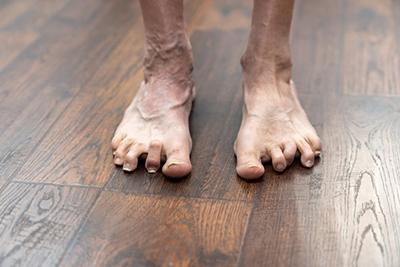
Hammertoes occur when one or more toes bend abnormally at the middle joint, creating a curled or claw-like position. This deformity often develops gradually due to muscle imbalances, arthritis, trauma, or wearing shoes that are too tight in the toe area. Over time, the tendons in the toe tighten, making the bent position more rigid and difficult to straighten. At Hampton Roads Foot and Ankle Specialists in Williamsburg and Hampton, VA, Dr. Sara Bouraee, Dr. Sonya Wali, Dr. Carl Belock, and Dr. Meng Liu help patients understand how hammertoes impact daily movement and overall foot health.
Impact on Walking and Mobility
One of the most common problems with hammertoes is how they can influence walking. Because the involved toe remains in a raised or curled position, it might be rubbing against shoes and creating friction, corns, or calluses on the top or tip of the toe. This repeated friction can be enough to build up pain that worsens with closed-toe footwear or walking far distances. In more extreme cases, hammertoes will alter the gait, since you will transfer some weight onto another area of your foot without realizing it to avoid putting weight on the problematic toe. This compensation can stress other areas of the foot, ankle, knee, or even lower back, leading to secondary pain and mobility issues.
Long-Term Foot Health Concerns
Hammertoes also cause stiffness and reduced flexibility of the toes. If the toes are not free to move, it disables the natural shock-absorbing function of the foot with each step, which threatens imbalance or falls. The pressure from the bent toe also worsens the ability to find comfortable shoes, thus decreasing activity levels and affecting the quality of life. Untreated hammertoes will eventually be fixed in a permanent bent position, and this renders nonoperative correction impossible and, in some cases, leaves surgery the sole option for relief.
Treatment and Prevention
Early intervention can help prevent hammertoes from progressing and minimize their impact on walking and foot health. Treatments may include wearing shoes with a wide, deep toe box, using custom orthotics to correct imbalances, performing stretching exercises to maintain joint flexibility, and applying protective padding to reduce friction. Inflammation and pain can often be managed with ice therapy and anti-inflammatory medications. For severe or persistent cases, surgical correction may be considered to realign the toe and restore normal function.
If you are experiencing pain, stiffness, or difficulty walking due to hammertoes, the team at Hampton Roads Foot and Ankle Specialists, Dr. Sara Bouraee, Dr. Sonya Wali, Dr. Carl Belock, and Dr. Meng Liu can help. Call our Hampton office at (757) 224-7605 or our Williamsburg office at (757) 220-3311 to schedule an evaluation and discuss treatment options tailored to your needs.